

In simple terms, performance testing is about making sure your application stays fast, stable, and reliable for users—no matter the load.
When I think about performance testing, I remember test driving my new 2.0L TSI turbo-petrol …………
I’d already reviewed the specs a million times. I’d spent hours comparing it with my current car. I’d admired others gliding it smoothly on the highway. The salesperson had finished walking me through all the “less exciting” features like heated seats or a heads-up display. But the real moment came when I got behind the wheel. On the test drive, I:
Pressed down the gas to feel the speed and responsiveness.
Checked the stability when I took a sharp turn—and noticed the speedometer screaming warnings at 120 km/h.
Saw how it handled uphill climbs and bumps.
And of course, I didn’t forget to glance at the fuel consumption—while the poor salesperson sat nervously in the passenger seat.
Because here’s the truth: a car may look perfect in the showroom, but you only discover its real performance once you drive it under different road conditions.
That’s exactly what performance testing does for your application—it takes it off the “showroom floor” of development and puts it on the “roads” of real-world usage.
My Definition of Performance Testing
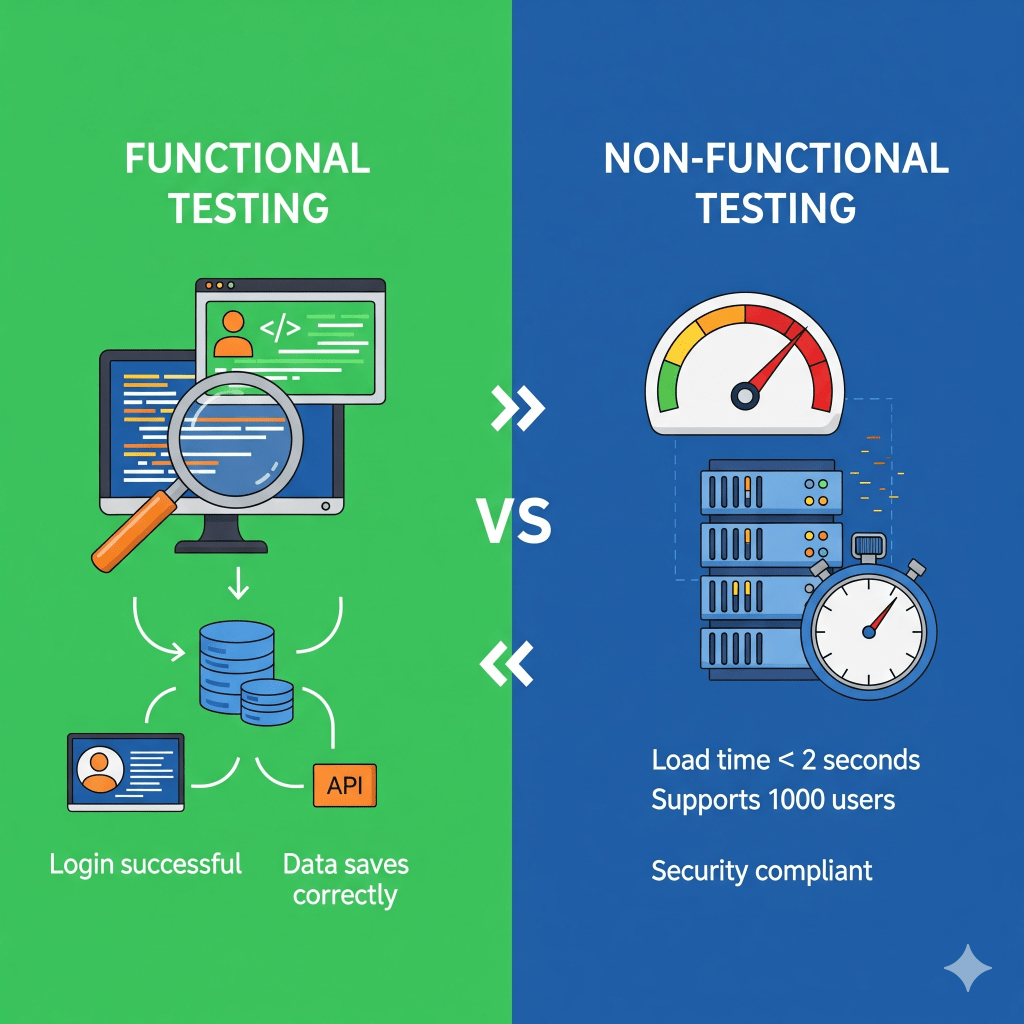
Performance testing is a non-functional testing practice that defines and validates performance-related requirements such as speed, responsiveness, stability, scalability, capacity, and reliability. It evaluates these requirements by simulating different workloads and usage scenarios in a controlled environment, measuring how the system behaves under varying conditions. The goal is to identify and address potential bottlenecks, ensure optimal resource utilization, verify compliance with SLAs and KPIs, and confirm that the application can deliver a consistent and dependable user experience in real-world situations.
Ultimately, performance testing serves as a quality gate before release. It validates that the application can handle real-world usage and meets performance benchmarks, giving both developers and stakeholders confidence that the system will run smoothly in production.


 Beyond metrics: the human side of testing.
Leave a comment